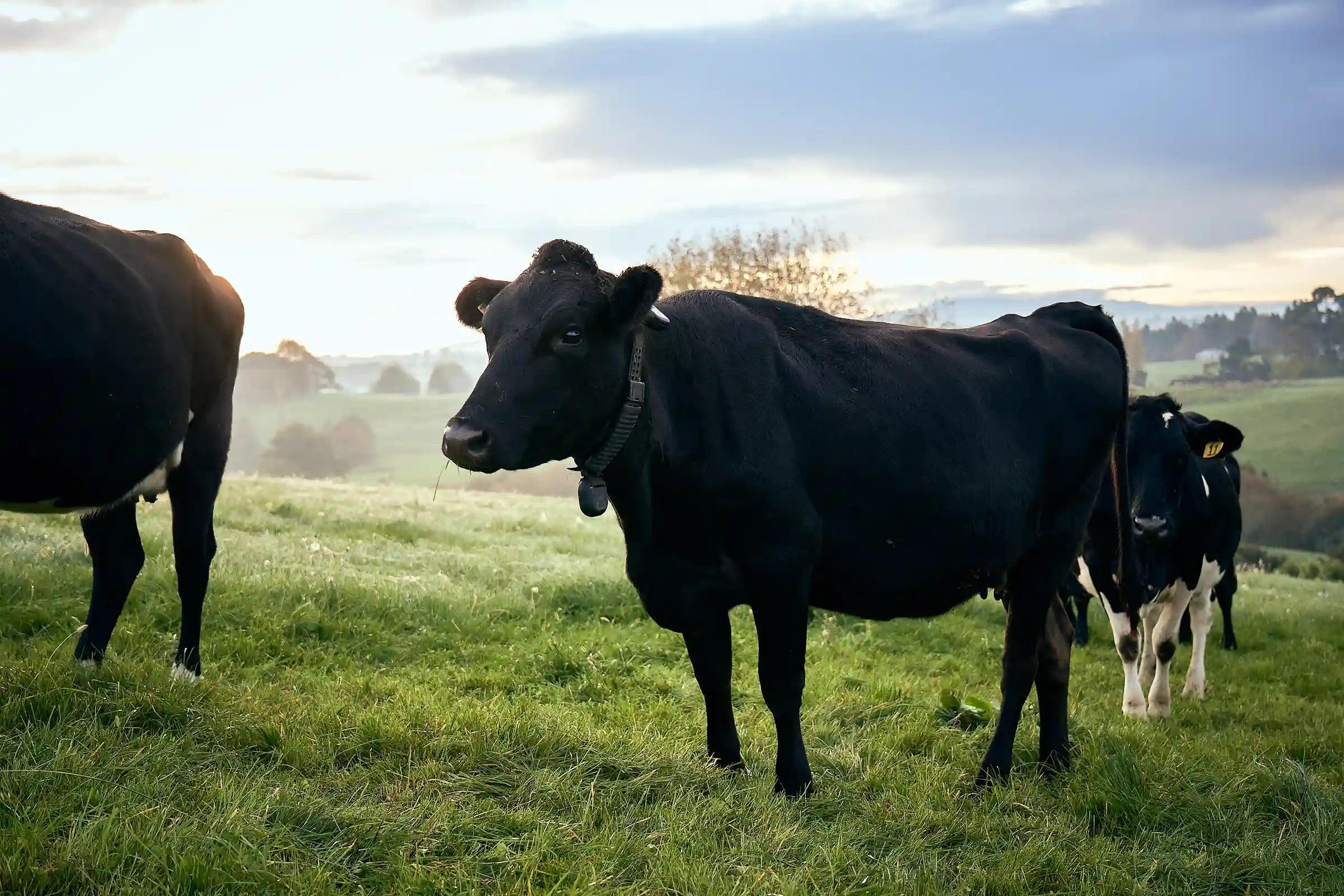


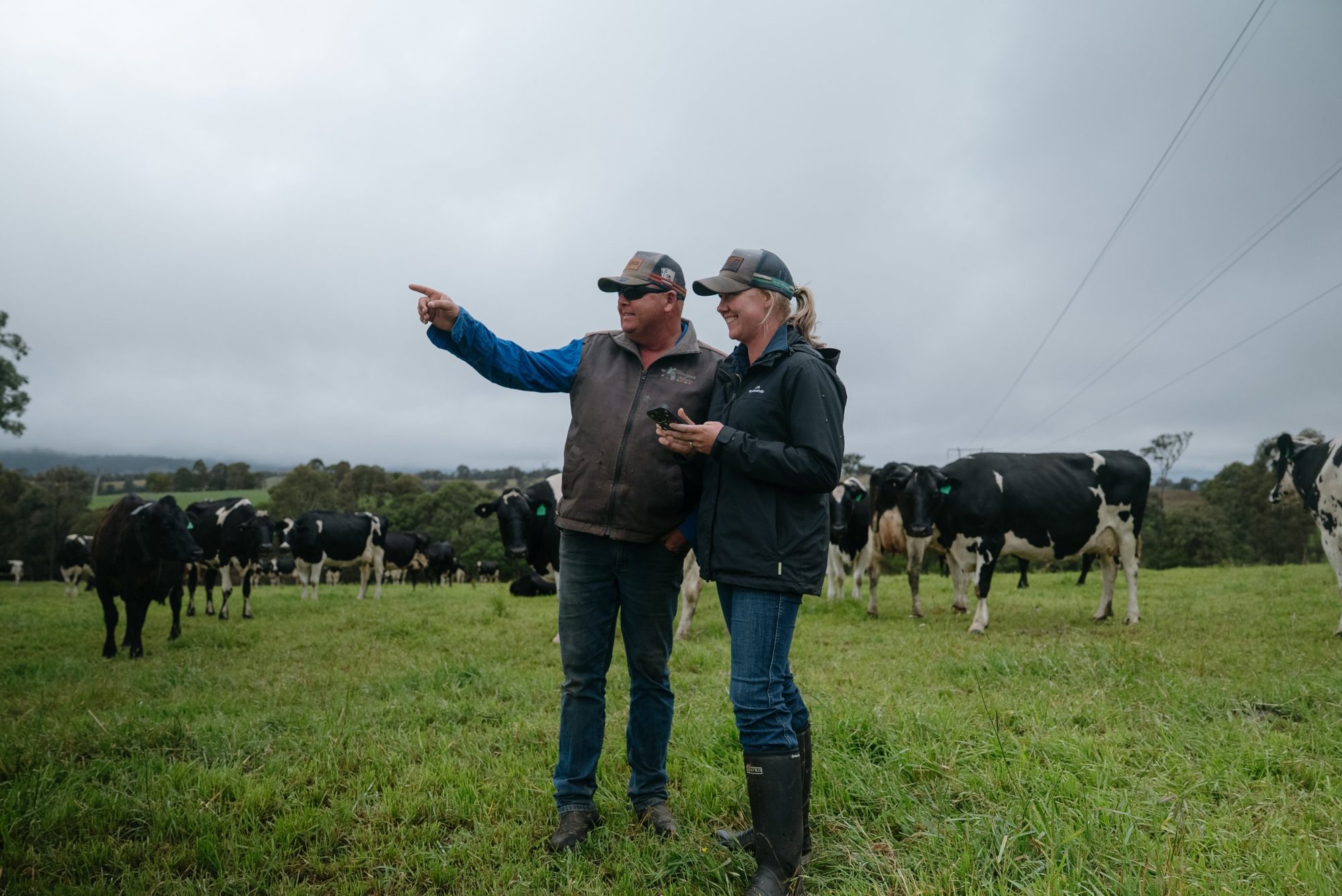
Six extra weeks out of the maize stack, and around $54,000 they won’t have to spend buying in feed. That’s what the first 100 days with Halter virtual fencing collars has meant for Brodie and Kevin Game, in a season that turned dry not long after the collars went on.
“Once that maize crop runs out due to the season, we are back to buying,” Brodie says. “So to be already able to extend that out an extra six weeks, you’re talking rough figures, you saved 54,000.”
It’s a long way from where they started. In 2010 they were milking two cows out west, rearing calves on the side and putting every dollar towards building a herd of their own. Today the first-generation farmers run Blackjack Holsteins at Bemboka, in the Bega Valley on the far south coast of New South Wales, Australia, where they milk around 430 cows year round on a 174-hectare milking platform.
On this stretch of coast, that buffer is everything. “In this area, it’s not a matter of if we’ll feed silage, it’s when,” Brodie says.

All in on Blackjack
When Kevin Game heard of the opportunity to share farm on a trip to buy bull calves, he pulled into the farm gates and pitched himself straight to the owner. He might have only had six cows, but he had a whole lot of knowledge to his name. A fortnight later the owner rang back with an offer, and their luck seemed to be turning.
However, just a few months in, the owner wanted out, and if they wanted to stay in dairy, they'd have to buy the whole herd and lease the farm.
"I think in life you have some really key fork-in-the-road moments," Brodie says. "That was one of those moments in life where I was genuinely upset at the prospect of not continuing in the dairy industry and what we'd created."
So they went all in, and the name came with it. "It sort of felt like everything was on the line, so we just put it all on Blackjack. It wasn't a case of red or black."
Since then they've worked through share farming and leasing to buying their home farm three years ago. One of the farms they lease is a place Kevin worked on as a young bloke. "I walked into the dairy and my name's still on the board from 2003."
Six weeks between a flood and a drought
"We've come to know that there is no average in the Bega Valley," Brodie says. "It's feast or famine, and it's six weeks between a flood and a drought."
They plan for it as best they can, making pasture silage and growing a maize crop each year, with the goal of having 12 months of silage in the pits as a buffer. Once the maize runs out, though, they're back to buying feed on the open market.
"There's so much financial risk in just buying when we need it," Brodie says. "Weather is something that's out of our circle of control, but it's still something that is a really big stressor, no matter how much you try to ignore it."
This season put that to the test, with a really dry spell setting in not long after the collars went on, and the corn silage in the pit pretty much all they had left.
Brodie likes to make decisions on evidence rather than gut feel, and she'd watched Halter from a distance for a long time. The farm already used wearables, but they were getting to the end of their life, and the team was jumping between three or four apps for pasture, growth rates, health and herd monitoring. The price made her pause at first, until she sat down and did the sums.
"We worked out that we only needed to grow an extra half a tonne of dry matter per hectare to pay for it," she says. "And then we sort of thought about it, and we knew we were wasting our residuals, so we didn't even have to grow it, we just had to physically eat it. So it became a no-brainer."
Kevin, on the other hand, took a fair bit more convincing.
"Yeah, a little unsure was an understatement," he says. "I thought the whole thing was a big gimmick to start with, and then Brodie sort of pushed to get it."
He did his own maths on what they'd save getting the cows in, or paying someone three hours a day to sit behind them. "That came to about 43,000 or 45,000, whatever it was, and I was like, [I'd be happy with] half of it. Hopefully we can find a bit more in it, but yeah, we found a lot more than a bit, that's for sure."
The whole herd was collared in just two days in June, and following that the data started flowing through. Where their old system needed 10 days to two weeks to set a baseline for each cow, Halter had data coming through almost straight away.

Knowing what's in front of the cows
Before Halter, the aim was a consistent diet of one green feed and one silage feed a day, 365 days a year, and while they kept to the rotation, they had no hard numbers on how much grass the cows were actually getting.
Residuals were the weak spot, and both Kevin and Brodie knew it. Getting cows back into yesterday's paddock, and holding them there with strip fences, was "near impossible, and just frustrating to no end."
"It's a cash cost you can't see, but we were essentially leaving money in the paddock," Brodie says.
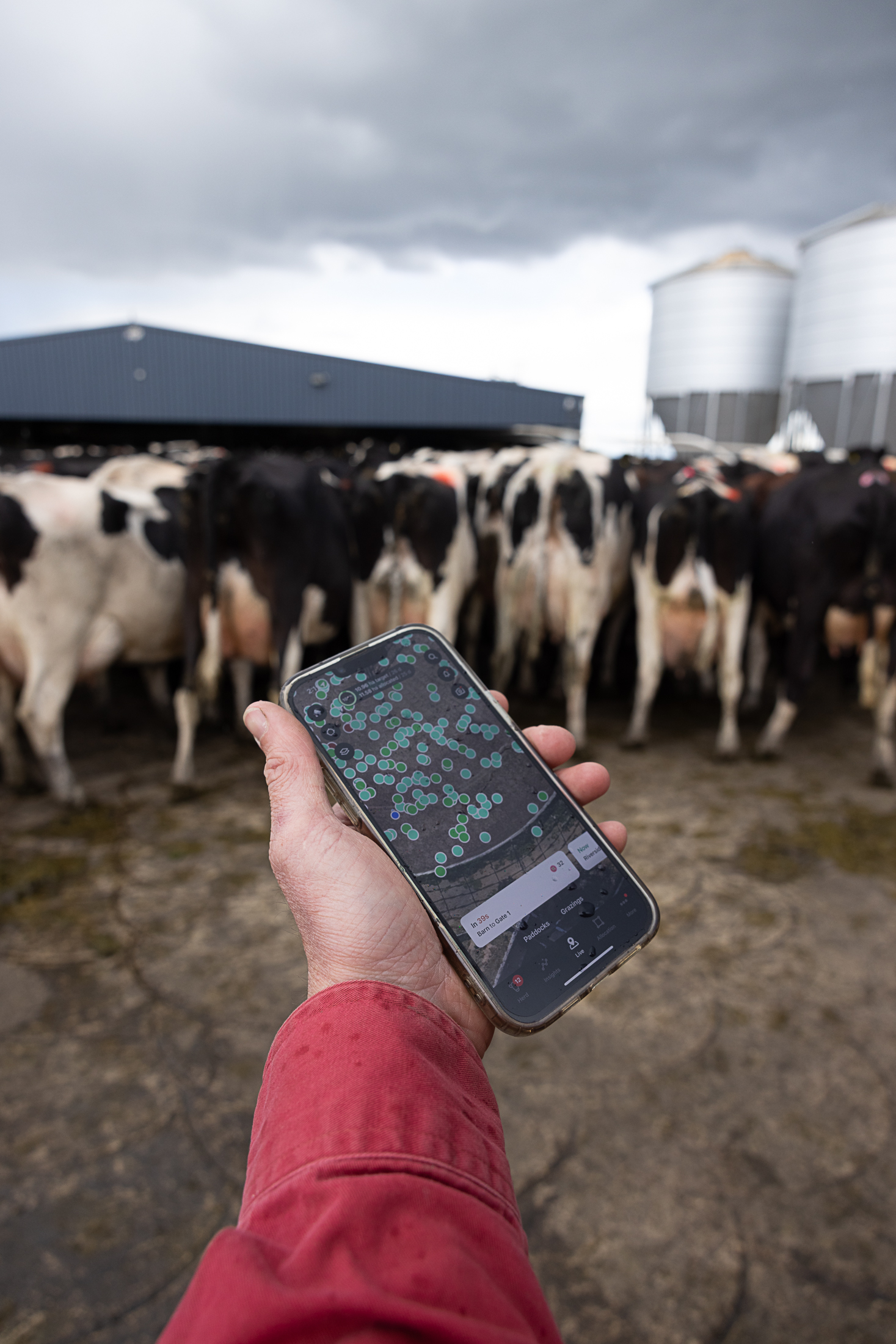
Now, they can see how much grass is in each paddock and how much the cows are being allocated. If the cows need more, they shift the break during the day, with no strip fence to roll up and run out again, and the silage is set against what's in the paddock rather than a fixed number.
"Rather than just feeding seven tonne a day for 400 cows, or whatever the figure might be, what we were feed budgeting on," Brodie says, "there are some days that if the allocated grass is 13 kilos, then perhaps the silage is brought back to two and a half tonne for the whole herd."
Kevin, who looks after the pasture side, puts it simply. "We nearly halved what we were wasting, basically." He can now look in the pit and know there are 87 days of feed left. "Before, it was all just a big guess."
Those half tonnes add up over a season, and six extra weeks out of the maize stack works out to about $54,000 they don't have to spend buying in feed.
"And it's not that we never had that, it's that we were wasting it before," Brodie says. "We're either wasting it by giving them too much in the troughs, or they were leaving it in the paddock. It's just money that you don't physically see."
The paddocks are bouncing back better too. With the cows grazing to an even residual, regrowth is more consistent and they no longer top paddocks, which saves fuel, time and wear on the machinery.
The growth data also flags problems early. That matters here, where red-legged earth mite is a constant battle. When one paddock is growing 40 to 50 kilos a day and the one next door is doing 20, Kevin knows where to look. "Sure enough, you go over there and it's full of red-legged earth mite," he says, and they can get onto spraying much sooner than they would have otherwise.
For a season of feast or famine, that's the real difference. "I wouldn't say a walk in the park, but there is so much less stress," Brodie says. "We know what grass is in front of us, we know how it's growing, and we're able to adjust based on feedback much earlier, so we can see what's happening before it's too late."

Calmer cows, and a team on higher-value work
Getting cows in used to mean someone on a bike behind the mob, pushing the tail-enders along the laneway. There's a narrow underpass under the road where the cows liked to stop in the cool on a hot day, and it took two people to get them through, one in front and one bringing them up behind.
Now the Halter collars cue the whole herd to walk to the dairy, and the cows keep moving through the underpass on their own, which Kevin reckons takes about half the time it used to.
"I spent the first month just watching the cows come home," he says. "It was just mesmerising. It looked like having a virtual dog behind me."
The flow-on effect has surprised them both. "One thing I've noticed in the herd is that the lameness has all but vanished, because we haven't got people pushing cows over rocks, putting them places they don't want to go," Kevin says. Milkings are calmer as well, because with feed allocated properly the cows are no longer underfed one day and overfed the next.
"To see cows happy, I mean, that's every dairy farmer's dream," Brodie says.
It's also made smaller changes much easier to try. The cows eat their supplement on a feed pad each night, and the first-row cows used to get there two or three hours before the last row, and those were usually the heifers and the cows that most needed the feed. In the fortnight before the 100-day mark they started holding the herd back with the collars, and with the gap now down to about 45 minutes, they're already seeing production lift in those last-row cows.
Before collaring, Brodie worked out they could save an average of 42 hours a week on setting up strip fences, getting cows in and shifting them. That time has gone into other jobs, with the team more on top of cleaning checks in the dairy, weaning and dehorning calves, and the young stock on the runoff block managed without hiring another person.
Getting 12 months ahead
The next goal is the one they've always had: 12 months of silage in the pits, so the next dry doesn't send them to the open market.
With growth rates in the app every day, they can see what a dose of slurry, a round of irrigation or a bit of rain is doing in each paddock, so they can lock paddocks up for opportunity silage earlier instead of making a snap call.
"We know how fast the rotation is already, based on how quick the grass is growing, so we can be so many more steps ahead of the game in terms of conserving fodder to create that stockpile," Brodie says.
They're also looking at splitting the herd and feeding groups differently, something that was too much work to try before, and at the 12-month mark they'll sit down and look at how much grass they've actually harvested.
"I'm yet to find a negative that's come out of the switch," Brodie says. "I think by the end of the first 12 months with Halter, when we sit down and have a look at how much we've actually harvested off our paddocks versus what we were doing before, I have no doubt that it will be hands down above and beyond."
Her advice to anyone weighing it up is short. "Just get off the fence. I don't think there is even a fence to sit on."
The Bega Valley will still swing from flood to drought, but these days Brodie and Kevin can see it coming sooner and plan for it with a lot less stress.

What could Halter look like on your farm?
Milking through seasons of drought or flood? Book a chat with your local Halter rep to talk through what 100 days could look like on your farm.