




Independent research on Halter
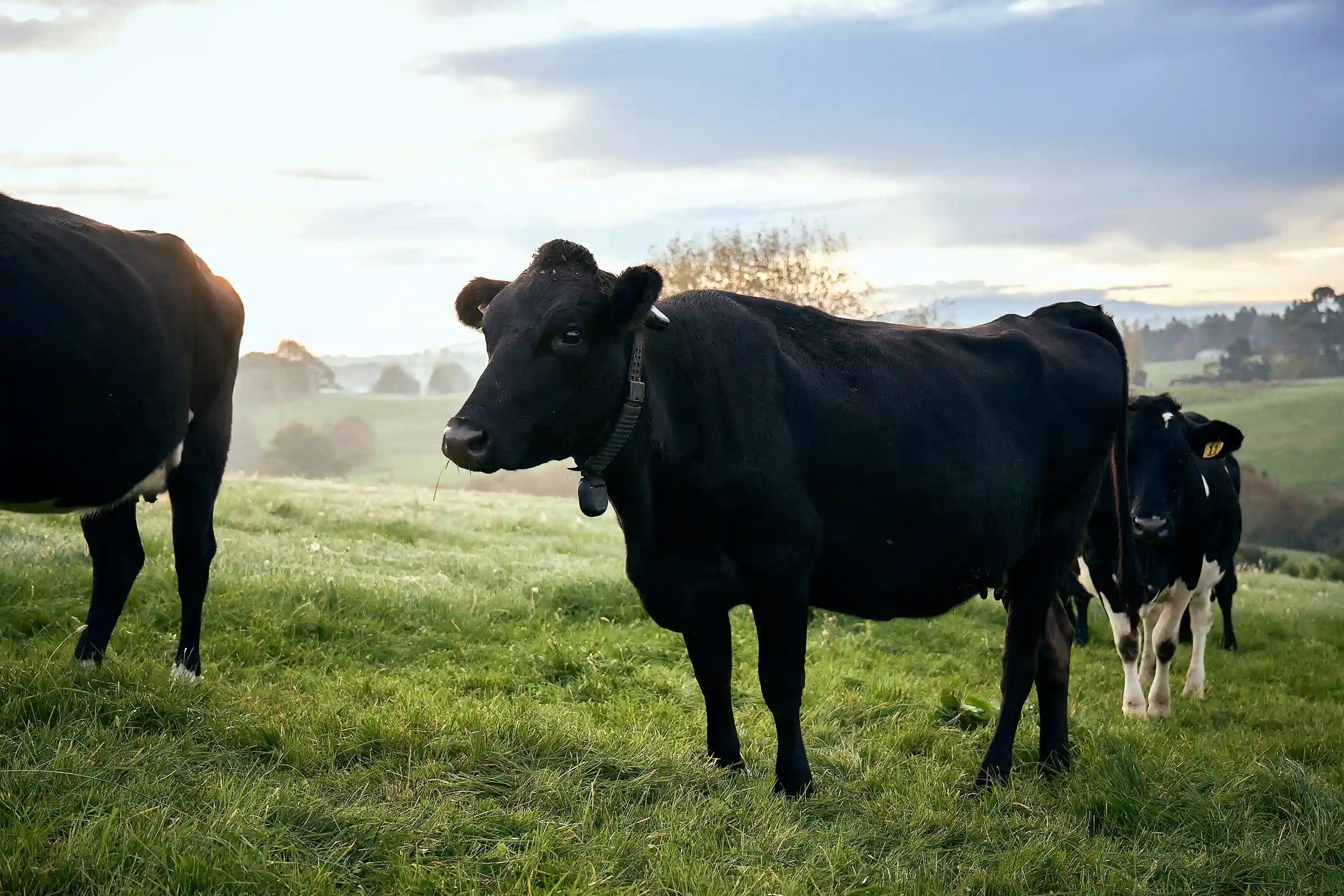
Internally, our team does continuous extensive research based on millions of days of cow behaviour in order to advance our system and improve animal welfare outcomes. Separately, the Halter system has also been subject to important independent research from the Tasmanian Institute of Agriculture (TIA) in recent years. These studies were led by Dr Megan Verdon, Research Fellow expert in animal behaviour with a focus in the development of livestock systems that achieve continual improvement in animal welfare and productivity. These studies are the most comprehensive research ever conducted into pastoral dairy cows and virtual fencing.
Dr Verdon’s first paper was published in the Journal of Dairy Science. The effectiveness of a virtual fencing technology to allocate pasture and herd cows to the milking shed.
Click here to read a summary fact-sheet and read below for an overview of the findings.
Study 1: Evaluating how effectively dairy cows can be trained and managed with Halter’s virtual fencing and herding system.
This study evaluated how effectively Halter’s virtual fencing and virtual herding technology could be used to train and manage dairy cattle within an intensive grazing system, including for containment and routine movements. It involved 160 rotationally grazed, lactating dairy cows of mixed ages, fitted with Halter collars over 6 weeks. It assessed the cows’ learning, responsiveness, and behavioural adaptation to the guidance cues, providing evidence of both the efficacy of the technology and the animals’ ability to understand and respond appropriately. This represents the most comprehensive study of virtual fencing on lactating dairy cows, and the first to study the Halter system.
Key findings:
- Halter can be used to effectively manage cattle with virtual fencing and (active) virtual herding.
- The number of pulses per day, and the pulse:sound ratio was lower in this study than previously reported virtual fencing technologies.
- Cows took less than a day to start responding to the sound cues delivered while held on a pasture allocation (virtual fencing) and were moving to the milking shed without human intervention by day 4 of training (virtual herding).
Training period and management period:
- During the 10-day training period, a typical cow received less than three low-energy pulses per day.
- During the 4-week management period (post-training), most cows received less than three pulses per week, and that number continued to decline each week.
- Once trained, the guidance cues that a typical cow receives each day are almost entirely sound and vibration.
Study 2: Assessing the animal welfare experience of cows managed with Halter’s virtual fencing and virtual herding system
This study compared cows managed with Halter's virtual fencing and herding system (VF group), to cows managed conventionally with electric fencing and stockpeople on quad bikes (EF group). It assessed multiple welfare indicators, including milk cortisol concentrations (a key physiological marker of stress), Body Condition Score, milk production volume, and behavioural measures. The trial involved 160 mid-lactation dairy cows assigned to four groups managed for six weeks. Notably, this study included the most comprehensive dataset of milk-cortisol measurements ever collected in a virtual-fencing welfare study globally.
Key findings:
- There was no evidence of stress responses in cows using Halter. Milk cortisol levels were not elevated in either the Virtually Fenced (VF) mobs or the Electric Fenced (EF) mobs, either during the VF training period, or in the next 4 weeks after training.
- There were no differences in rumination time, pasture consumption, milk production, live weight, and Body Condition Score between the two management systems.
- Notably, even in the initial 10-day training period when VF mobs experienced the low energy pulse, it did not trigger a stress response. This shows that even while cows are learning virtual fencing there is no evidence of an increase in stress or welfare harm.
These results align with our internal data and years of feedback from customers who report that their animals adapt well to the technology.
This research is expected to be published in Animal Journal in 2026. Click here to read a summary fact-sheet of the findings.
Further research study with the Tasmanian Institute of Agriculture focused on Halter’s technology
TIA is leading a longitudinal (multi-year) study that quantifies the benefits of Halter for pasture production, labour requirements and animal performance. This study has been established to build an in-depth and long-term understanding of the impacts of Halter’s technology. The study has been undertaken in partnership between TIA, Halter and Tasmanian farmers, with support from the Tasmanian Government’s Agricultural Development and Agricultural Innovation Funds. This study commenced in 2024.
General research on animal welfare and virtual fencing technology
Halter implements best practice from the scientific literature on animal welfare and virtual fencing technology, specifically from:
- Published academic research on virtual fencing technology, for example, by Dr Megan Verdon, Research Fellow at the Tasmanian Institute of Agriculture (TIA), and by Dr Caroline Lee, who leads the Animal Behaviour and Welfare Team at CSIRO (Commonwealth Scientific and Industrial Research Organisation) - both leading researchers in the fields of animal welfare and virtual fencing technology.
- The Five Domains Model - developed by Professor David Mellor and Dr Cam Reid. This is the leading standard for categorising the assessment of animal welfare into the domains of nutrition, physical environment, health, behavioural interactions, and mental domain.
- Published opinions of regulators based on detailed literature reviews:
- The New Zealand Animal Welfare Advisory Committee’s Code of Welfare Evaluation Report Dairy Cattle, Ministry of Primary Industries (2022).
- The UK’s Animal Welfare Committee opinion on the welfare implications of using virtual fencing systems to contain, move and monitor livestock (2022)
- The Opinion of the Panel on Animal Health and Welfare of the Norwegian Scientific Committee for Food and Environment: A review on the use of electric devices to modify animal behaviour and the impact on animal welfare. Mejdell CM, Basic D and Bøe KE. (2017).
- Report to the [Australian] Department of Agriculture, Fisheries and Forestry. An independent scientific literature review on animal welfare considerations for virtual fencing. Fisher A & Cornish A (December 2022 updated November 2023)
- Halter’s published opinion on regulatory approaches:

