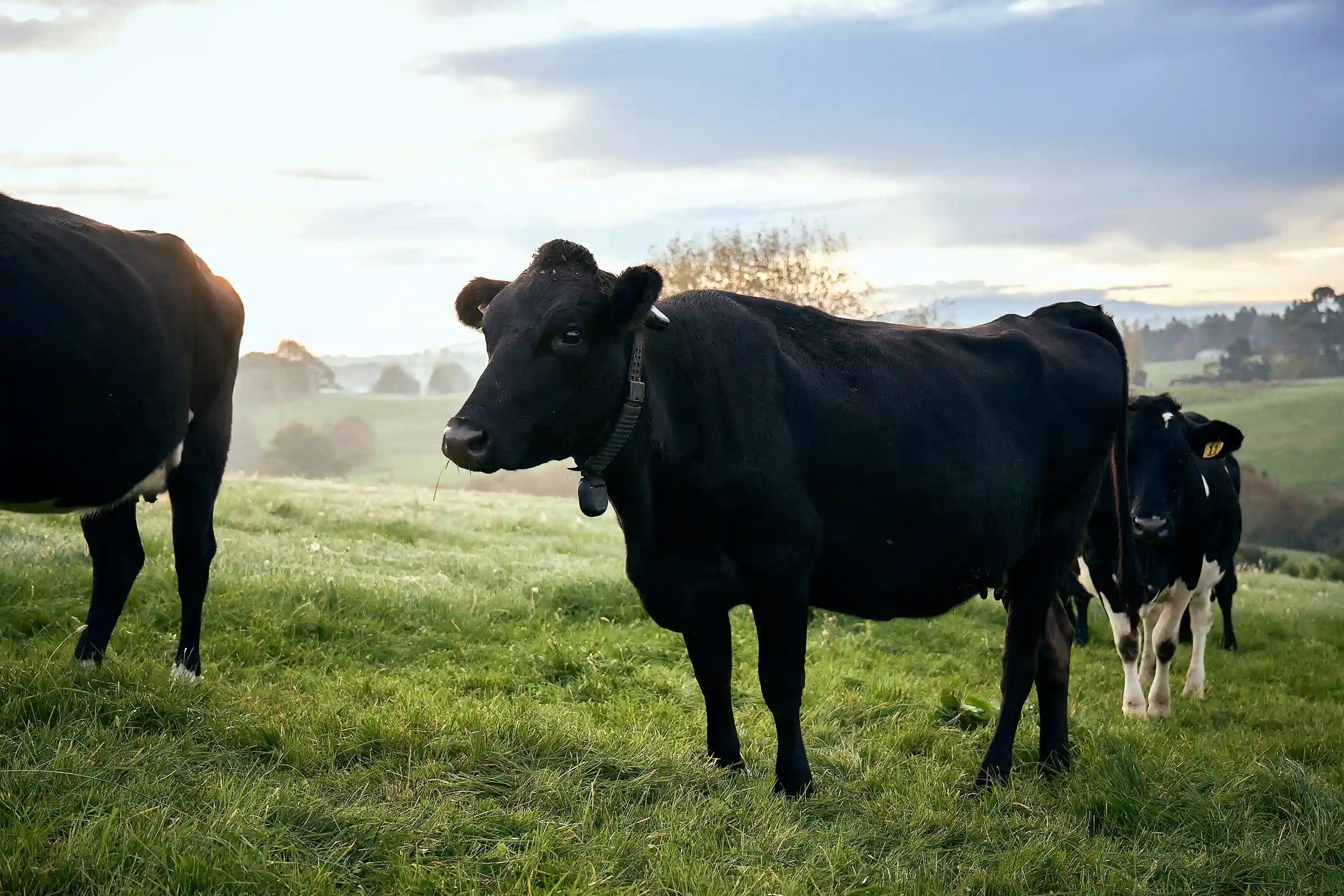



Agtech company becomes first to provide virtual fencing via satellite, unlocking virtual fencing for beef properties previously beyond reach.
Halter, the world’s leading virtual fencing operator, today announced the first steps in a global rollout of direct-to-satellite technology for its smart cattle collars.
When using the new technology, farmers will be able to monitor and control livestock without the need for on-farm transmission towers.
The Halter smart collars will connect directly to the Halter app via satellite. The collars will operate anywhere you can see the sky.
The advancement will dramatically increase the areas where Halter can be used, including across remote and rugged regions where relay towers are impractical and mobile phone coverage is patchy.
Halter with satellite will be available to farmers in the United States and New Zealand immediately. An Australian launch date is expected shortly. Halter also announced a suite of new tools for reproduction, animal behaviour, and precision pasture management, significantly expanding what is possible for cattle management.
Direct-to-satellite will open up virtual fencing for beef producers in regions like northern New South Wales, Far North Queensland and the wider Mallee region in Victoria and South Australia. The increased connectivity also positions Halter for expansion into more remote markets globally, such as South America and parts of Africa.
Halter’s GPS-enabled collars use audio cues and vibrations to train cattle to respond to virtual boundaries, allowing farmers to move and manage herds from a smartphone app without physical fencing.
Until now, the system depended on Halter’s proprietary on-farm LoRa (long-range) radio towers.
Craig Piggott, Halter founder and CEO, said the advancement will dramatically boost access to virtual fencing and herding.
“We've always known virtual fencing had the power to improve farm operations. Connectivity was the blocker for the most remote or large operations. Direct-to-satellite removes that.
“This means farmers managing huge and remote properties can now access the same technology as operations with full cellular coverage. Combined with our new suite of product features, these farms can be even more productive,” Piggott said.
Steve Wilkins is the General Manager of Aminya Pastoral, a group of Queensland and New South Wales properties spanning 130,000 ha.
Mr Wilkins said he can’t wait to be among the first in Australia to deploy the satellite-enabled collars. “The opportunities that Halter’s satellite solution provides our remote properties make the technology decision a no-brainer,” he said.
“We expect to lower costs associated with mustering, including labour expenses and bike repairs and maintenance, while driving animal productivity gains, through more effective pasture utilisation across large areas, and increasing livestock density without major capital investment in fencing.”
“This will also allow us to improve the way we graze livestock on large properties by resting more country for longer periods, and rotating animals more frequently to maintain them on a higher plane of nutrition for longer, much like the dairy industry has done well.”
Alongside the satellite launch, Halter has rolled out its largest-ever features upgrade for beef farmers. The update includes an all-in-one heat detection tool to identify non-cycling animals before breeding, a new behaviour tool providing near real-time insight into how feed allocation and pasture quality are influencing cattle performance, and advanced grazing features including high-resolution pasture mapping, pasture metrics, zone and block management, and a feed demand calculator.
See factsheet for more.
Halter farmers in Australia have already created around 78,000 kilometres of virtual fencing, and globally this reaches nearly 900,000 kilometres, or more than 21 laps of the Earth.
To learn more, visit halterhq.com/beef
Media Contact
Ryan Sheales
+61402 351 412
ryan@theagendagroup.com.au
About Halter
Halter serves more than 2,000 farmers and ranchers across New Zealand, Australia and the United States, and has now sold one million of its solar-powered, GPS-enabled collars. The company is headquartered in Auckland, New Zealand, with Australian operations based in Melbourne and a U.S. office in Colorado. To learn more, visit www.halterhq.com.
%20(1).png)