


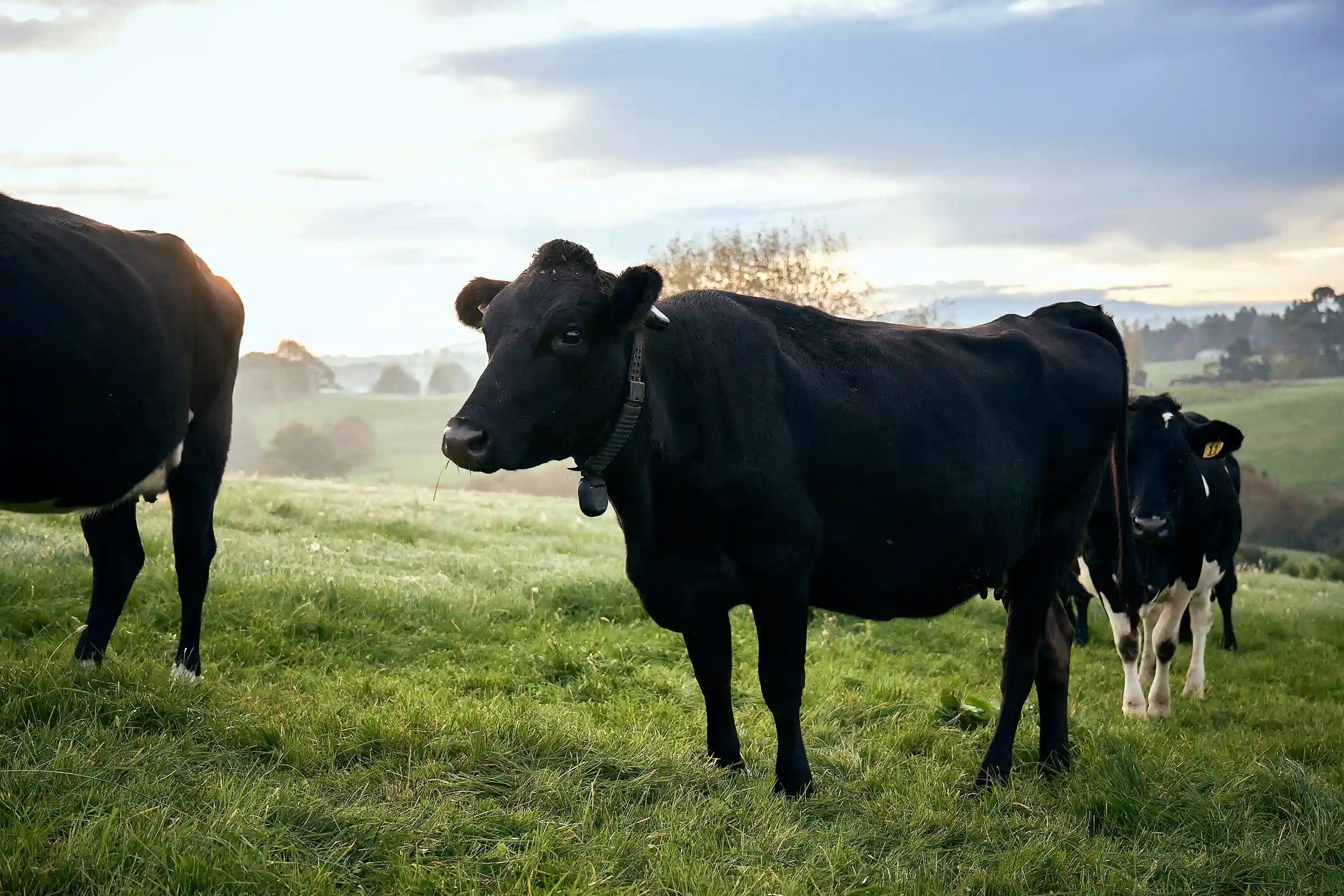


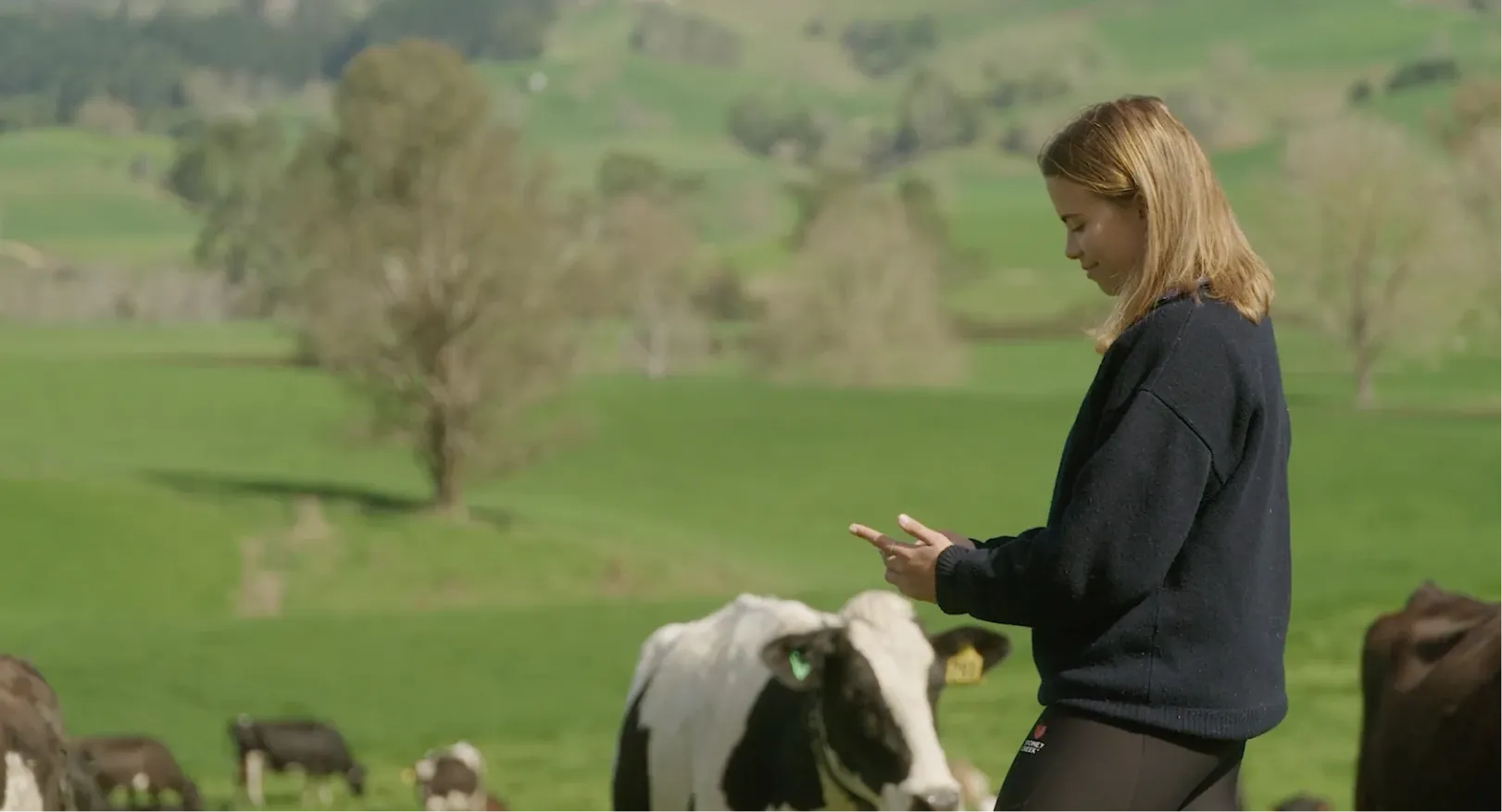
A cow’s learning experience
Traditionally people have considered training animals as a way of getting them to do what we want them to do. More recently we have come to understand just how intelligent many animals are and to gain new insights into how they learn. Although we talk about training in this section, it is a core principle of Halter to liberate and allow them to be cows. Halter recognises that cows learn best if they respond to cues with the least possible human intervention. Watching cows learn to respond to the Halter system provides behavioural insights for stock handlers to better understand their cows and their needs. The emphasis in the Halter training process is to encourage farmers to learn this new way of interacting.
The animal training and learning experience
Training is a core capability in Halter’s service and is mandatory for farmers and their cows. Precise and effective training of animals is essential to protect the welfare of virtually fenced animals.
Cows are intelligent, and generally show significant progress in their understanding of guidance cues within the first 24 hours of training. However, Halter prescribes a full training programme of seven days (for dairy cows) and 10 days (for beef cows), with specific daily monitoring and training modules assigned to farm staff to follow. Halter’s comprehensive training programme is overseen by Halter staff with the necessary farming and animal management experience.
The primary objective of training is for cows to perceive the primary cues as predictable and controllable so that they know what to expect and how to avoid a secondary cue (Kearton et al, 2020). This is achieved through associative learning (Lee & Campbell, 2021; Kearton et al., 2020).
The delivery of training on commercial farms is guided by these standards:
- Dairy cows must be at least 12 months old; beef cattle must be at least 8 months old;
- Before training commences and cues are activated, animals should be settled in their surroundings and in a routine that the farmer will continue;
- During training:
- Farmers should support their herd during training as per the guidelines outlined for each stage of training;
- Accuracy of learning takes precedence over speed of learning;
- Social learning is central to the development of behaviour within a group. Animals learn from observing other animals in the group, particularly high status animals and trained animals.
- Training must ensure that the animal comes to understand and react appropriately without becoming distressed. Following a successful training period, primary cues must be perceived as predictable and controllable for the animal. The system must ensure that cues are delivered consistently to each individual animal.
- Animals must be comfortable wearing their collars; and
- If an animal does not show any progress towards understanding the cues, this must be flagged to the farmer for resolution. If necessary, training of that animal should be aborted.
Observations of training
The training of cows to the Halter system is a relatively benign process compared with, for example, training to a physical electric fence. Typically, before a cow is trained, as she first approaches a virtual fence she will not stop when she hears the sound cue. As she continues forward, ignoring the increasing frequency of the sound cue, she will ‘start’ when she gets an electric pulse and will back off or turn away. Whilst cows ‘start’ at first contact with a pulse during their initial training, they do not leap back, vocalise or violently shake their heads, and they generally return to grazing within a few seconds. Cows quickly learn to associate the sound cue as a warning for a pulse, and thus they learn to change their direction to avoid receiving a pulse. The application of the pulse depends on the behaviour and location of the cow. Halter cues are behaviourally led, not externally imposed.
Typically the full training process takes seven to ten days. Animals are monitored continuously to identify any animal that might be confused or not understanding the guidance cues – if so, our specialist team intervenes accordingly and takes appropriate action which could include aborting training for that animal if necessary.

