


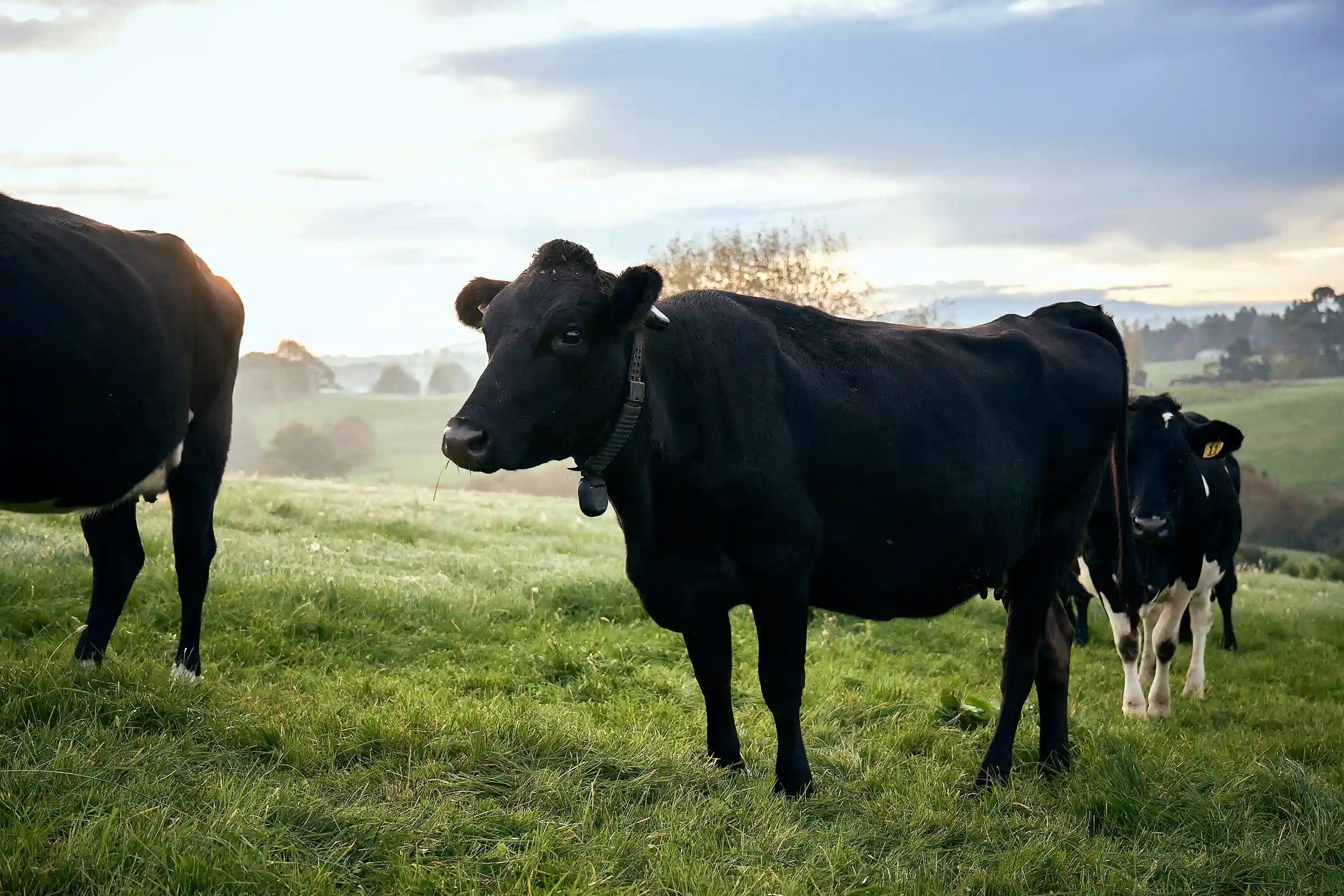


Halter’s health monitoring and alerts
A healthy cow is a happy and productive cow. Halter improves a farmer's ability to manage animal health in ways conventional farming doesn't always allow. Cows are stoic animals that tend to hide early signs of sickness or injury - an evolutionary hangover from being a prey species to avoid threats from predators. This makes it difficult for farmers to consistently detect early signs of sick or injured cows. Furthermore, conventional animal husbandry practices typically involve a small number of people observing hundreds, and in some cases thousands of cows, a couple of times a day, to identify and treat sick cows. This is on top of the countless other jobs they juggle on farm every day.
The Halter system provides 24/7 monitoring of the behaviour of each cow. Halter continuously monitors each cow’s grazing, rumination, resting, movement and location. The Halter app displays each dairy cow’s real-time and historical data across these behaviours. Halter compares each cow’s actual behaviour against her historic or ‘usual’ behaviour, and that of her mob. Every Halter farmer has access to this data in real-time, affording them deeper insight into the behaviour of each cow and mob.
Dairy farmers can also receive proactive health alerts of cows showing early signs of poor health. This helps farmers be proactive at managing and maintaining animal health. Many Halter farmers create a "resting" or "sick" mob for close monitoring and treatment, in response to a health alert.
Every day, Halter alerts farmers to thousands of cows that may be displaying early signs of illnesses. This allows farmers and veterinarians to then analyse that cow’s historical behavioural data and physical condition to directly assess them. Animal health detection technology is complex - no monitoring system, whether human or digital, is perfect at detecting every health issue of every cow. While Halter’s health alerts are a significant complement to ongoing human observation of cows, the Halter system does not yet detect or diagnose every health issue. As such, Halter is not a substitute for a farmer’s duty of ongoing care and observation of cows.
Halter’s health alert system is comprised of two alert types:
- Gradual health declines (including chronic, long term health issues): Halter reliably detects and alerts for cows that show sustained behavioural changes associated with health or nutritional issues. It is difficult to determine the exact accuracy of these alerts, as cows with visible signs of illness do not necessarily change their behaviours significantly enough to trigger alerts, and cows with behavioural changes associated with health issues do not necessarily look sick to a farmer. Based on a test data set of cows showing visible behavioural changes, Halter sends health alerts for ~80% of such cases.
- Rapid health declines: It is more challenging to detect and alert cows who have a rapid health decline using behaviour data alone, as it is difficult to distinguish these cows from those who are simply resting. We have developed algorithms which detect cows with specific behavioural patterns that indicate a serious health concern. These cows are identified via a “critical alert” to farmers.
Other features help to provide further oversight of animals. For example, farmers will be alerted via their app if a cow has not left the paddock after scheduled virtual herding has finished. This alert can indicate that an animal might be down, or unable to move to their designated location, helping farmers to physically observe the animal.
Halter farmers can adjust the sensitivity of the health alerts they receive, to help them fine-tune the alerts based on their farm, their knowledge of their animals, and the specific time of the season. On high sensitivity, Halter sends more alerts overall, and cows with clinical health issues are more likely to be alerted, but the cows which do get alerted are less likely to show clinical signs. Whereas on low sensitivity, Halter sends fewer alerts overall, so that cows with clinical health issues are less likely to be alerted, but the cows which do get alerted are more likely to show clinical signs.
Benefits of virtual herding
Halter’s animal guidance can reduce non-environmental lameness in a way not possible with most conventional methods of stock handling. Anecdotally, many of our customers have reported that Halter's animal guidance technology reduced non-environmental lameness after they adopted Halter.
The conventional method of shifting animals involves pressuring animals from behind, typically with people, dogs or motorbikes, to move a group forward. This pressure disrupts their natural hierarchy and can cause bunching. Factors associated with movement of cows to the dairy shed account for 40% of the variation in lameness prevalence (Chesterton et al., 1989), and every 1 km/h increase in the average speed of movement increases the risk of lameness by 5% (Bran et al., 2018).
With Halter, cows move at their own pace, in their natural hierarchy for every shift. Each cow gets unique guidance cues based on their behaviour and location. By walking slowly, cows can put their heads down to observe where they are placing their feet. Larger groups are slower moving than smaller groups, so Halter’s cue system adapts according to group size and location, to allow for movement. For example, the larger the group, the more time the system allows the mob to shift through a gate to a new location.
This phenomenon of reduced non-environmental lameness amongst Halter groups is currently the subject of independent research being conducted in Australia.
Enhancing animal husbandry
Cows are the heart of a cattle farm. The farmer will always be primarily responsible for managing their cows. Halter helps farmers to carry out their duties as responsible stock handlers. Halter equips farmers with deeper insights about their animals, more tools and more time to carry out their responsibilities in a superior way. Halter doesn't replace human oversight, instead, it enhances it. The Halter system enhances animal husbandry through transforming the ways in which animals and humans interact to allow animals to behave more naturally and independently, with less of the disruption to social hierarchies and preferred behaviours that result from traditional farming techniques.

